Thursday, 15 November 2012

'Supers' full of honey - the bee training continues.

Bob called me over this evening to look at three honey filled 'supers' that he had in his garage. They had come from some other hives that he had in Taunton and are going to be used to feed the hives here in Ashcott. A super sits above the queen excluder above the brood chamber in the hive and is where the honey is laid down in capped off cells with no grubs. It has been a really lean year for the bees and this honey will help sustain the colonies over the winter in the hope for a better season next year. You should only take honey when there is plenty of extra as if you deprive the hive then the colony can diminish in size and vigour and you could loose them over the winter. Hives can apparently contain anywhere between 20 and 100,000 bees ! Bob has extra supers on some of his hives so that the brood chamber and extra super provide a really solid foundation for the bees over the winter. Bees apparently live as house bees for 3 weeks building cells, gluing things with propolis, feeding grubs and the queen, guarding the door, fanning queen scent into the atmosphere to guide foragers and other tasks. When it's particularly cold the bees come out and fan their wings on the outside of the hive to generate heat before going back in and taking turns to share and benefit from the the warmth. Once the bees graduate at about 22 days they become foraging bees and set of to hunt for water, pollen and nectar from within about 2 miles of the hive. They do this for 3 weeks before, at less than 2 months old, unless squashed, eaten or poisoned, they die of exhaustion.


Each frame can hold up to about 4lbs of honey which you get out by cutting the top of the capped cells with a hot knife and then spinning the frames in a special device. In the picture beneath you can see capped cells in the midde. The frames within the super are an interesting mix of the man made, straight wooden frames and the insect made, organic, hexagonal organised chaos. There is a beautiful sweet smell rising off the frames as you hold them, surprisingly heavy and dripping with honey. 
So much to learn.


Monday, 12 November 2012

Memories of Warmth

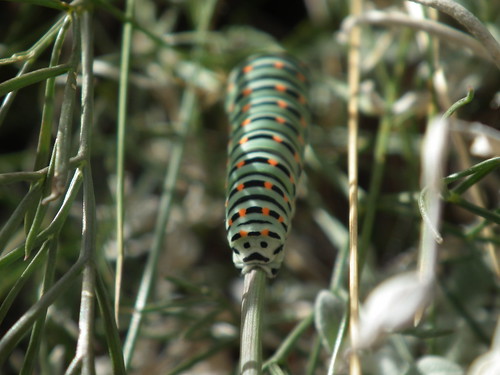
DSCF3767As the mornings regularly greet us with a light frost and a chill wind, it seems hard to recall the feel of warm sun we had just a few short weeks ago in Italy. A couple of the highlights included a walk in the high alpine meadows of the Sibillini mountains, where large butterflies flitted across our path, thriving in huge numbers. We even came across this Swallowtail caterpillar - something I've never seen even though we live close by their Norfolk heartland.

But our last morning there gave a last moment of contact with the local wildlife. Strolling down to our usual breakfast spot, looking across the rolling, lightly wooded slopes towards the high mountains, a blue sky above and a gentle sadness at our imminent departure inside, I noticed that amongst the grass, in the shade of an olive tree was resting this beautiful hind. Our eyes met for a moment as I clumsily took a photo before she clambered to her feet and, unsteadily at first, trotted off into deeper cover. It was one last taste of the bucolic idyll that had surrounded us for the week. Something in the set of the landscape, in equal parts wild and settled, gently animated with sun-kissed life, just seemed to resonate with something deep inside me - was this a more 'natural' way to live? Maybe it was just the beauty of the place, but there seemed to be a deeper connection, a more equitable balance between man and nature in those hills, so long settled by man but somehow treading more lightly than in intensively inhabited southern Britain. Of course, being a casual holiday-maker one is in a privileged position not least in the ability to merely soak in and enjoy such moments. But the privilege continues - I can hold that moment in my mind's eye and know that it will sustain me until I feel the warm sun on my back again. 

Sunday, 11 November 2012

Beekeeping beginnings.

Spent a wonderful morning with Bob, along the path opposite my house, having made an approach to ask if he would mind me talking to him about keeping bees. He didn't mind 'at all' and after 3 hours of bee talk I am much better informed and raring to learn more. Bob has been keeping bees for 40 years and I am going to help him in the coming year to learn the ways of the beekeeper. We got on really well which is great as there is clearly a great deal to learn. What is particularly nice is that although I am of course interested in the production of honey I am perhaps more interested in the work life of the insects themselves and a very 'busy as a bee' life it is !
Here are the 20 or so of Bob's hives with local bees and a few hives with a different strain of hardy bees from Snowdonia in Wales and some French ones also.

Bees coming in after flying in the autumn sunshine collecting pollen from the late flowering plants and arriving at the hive entrance on the landing board.

An open hive. This small hive had contained a 'nuke' ( nucleus of a new colony ). Unfortunately the colony have died or moved on but the evidence of their initial work was there to see with the brood chamber frames all sealed into place with propolis.

Old frames full of 'dross' to be cleaned over the winter in preparation for setting up new brood chambers with larger frames and super's with smaller honey frames. Far too much to write down her but we talked about how to catch a swarm, what smoke does, the life of the bees, queens, how to look after the hives over the year, how colonies generate heat during winter and the importance of being calm and not panicking. More later as the seasons progress. I need to get a suit.

Tuesday, 6 November 2012

Insect Lab


Found the work of US artist Mike Libby online. Wonderful quirky sculptures combining watch parts and insect specimens. Terrific combination of found objects, specimen, intricate detail, precision and suggested fantastical function. Wonderful interesting objects.

Quote from Mike Libby's website: http://insectlabstudio.com
'Robot-like insects and insect-like robots are the stuff of science fiction and science fact.
Often in science fiction, insects are frequently featured as robotic critters.  There are many examples in TV, movies, video games, comic books, even on album covers.  From Cronos to The Golden Compass, the insect/robot archetype has been used, re-used and re-imagined countless times.
Both biologists and engineers look to insect movement, design and social behavior to inspire new technology and applications.  Some of the most advanced aircraft is smaller than a dragonfly, and NASA scientists are making walking rovers and “swarm theory” probes for planetary exploration.  Technology is finding that the most efficient design features comes from natural systems.'


Sunday, 4 November 2012

Locust Birth

A group of my locusts have all recently matured into adult specimens. They seem to respond to sudden feeding, as when presented with a glut of new brambles last week the juvenile locusts all hatched out in the space of a few days. 

They crawl up onto the branches and whilst clinging upside down they remain still for a few moments and then begin the slow process of shedding their immature skins. It seems incredible that the large adult specimen can appear from the juvenile form, the insect doubles in size and the soft adult must somehow mature within the juvenile whilst still wearing it's youthful skin. How can one form exist almost perfectly grown within the smaller still functioning form ? To sit with the children watching the  unfolding of the adult is astonishing, as the new head, thorax, abdomen and legs imperceptibly shrug out of the smaller skin as if extricating from a tight wetsuit. The new adult form then hangs from it's abdomen for an hour or so as the wings unfurl and stiffen leaving the abandoned shed skin husk, with it's functionless wing stubs, hanging on the bramble. If left in the tank the locusts eat the shed skin.


Thursday, 1 November 2012

Hiding from the cold

Thursday: After a terrific autumnal family meal in Strumpshaw, Adam and I went to look at a small wren that I had seen squeezed into a small space under the roof of the boiler shed. The wren was still there, small and alert under the eves, and we talked about how we had heard that wrens can sometime congregate in the 100's in nest boxes to keep warm as the weather gets cold. Inside the boiler shed itself there was also a long eared bat suspended from the joist on the ceiling. I have seen long eared bats in the boiler shed before but this is the first this year, with it's ears curled up almost mechanical in appearance folded against the roof - like the creature in the shuttle unfolding in Ridley Scott's film Alien.

Note: On Friday evening there were 2 bats on the ceiling but when I looked during Saturday daytime there were no bats in the shed. Presumably they roost in the day and fly during the night but I have only seen them in the shed at night and only in the colder months of the year so presumably they roost elsewhere in the summer.