Sunday, 2 December 2012

Pupae Identification - 'Puss Moth' ?

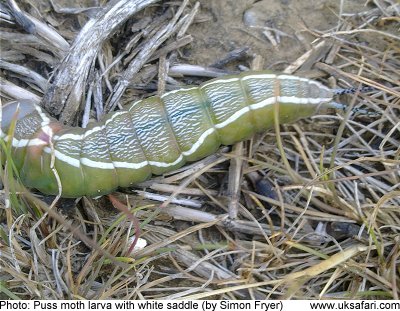
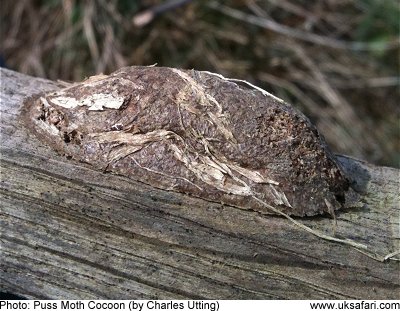
With the wonders of the internet I can now suggest that the pupae you have found could be that of a puss moth perhaps, what do you think?  It does indeed look very like a pellet with the stringy elements.


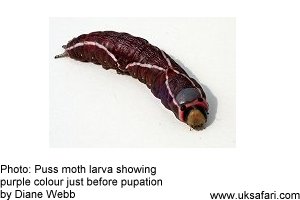
'The puss moth caterpillar has a green body with a black or brown 'saddle' on its back, which is bordered in white.  There can be variations in the colour of the 'saddle'although the white lines are always present.  The head has a bright orange ring around it with two false black eyes.  Just prior to pupation most of the body turns orange and then purple but the white lines remain.
The rear legs have developed into long whip-like appendages which it flails around when in danger.  As an extra defense it can spray formic acid from its head.
The puss moth caterpillar overwinters on tree trunks, or wooden posts, inside a tough cocoonwhich resembles a limpet shell.'
FROM -  http://www.uksafari.com/pussmoths.htm


Pupae?

Out walking on a crisp, wintry day, I found this case in a cleft in the bark of a local oak (a loakal?). I
can't claim to be too certain on what it is other than an empty pupae case - possibly from a moth? It is beautifully articulated, with striped segments not dissimilar to a wasp. It was attached to the tree with some silk, but the way it was wedged in to its deep crevice meant that it would have stayed without it. Its placement provided fantastic protection, which  once it was empty was exploited by a little spider that scuttled out after I inadvertently dislodged it.


Dorcas Casey's finches.

My friend Dorcas Casey makes the most wonderful sculptures and as I assemble a sheet of inspiring sculptural images, to hand out to my level 2 art students this week, I thought I'd post a couple of Dorcas's finch sculpture images, assembled from wire, found objects and vintage ink dip pen nibs.


I have also attached the 'Animal Sculpture' sheet that I am giving my students, as it collects together a wide range of interesting ( *at east I hope the students will find it interesting) animal inspired 3D work.


Saturday, 1 December 2012

Anatomical Garden Tiger

I'm thinking about making a sculptural piece which combines an intricate wax anatomical model with some pinned insects. With this in my mind currently I also decided to donate a postcard to an art student fundraising auction at Newcastle University and so bought a moth and anatomical study together in a drawing. There is in my mind something Victorian about moths, and also anatomical drawings, and I feel the combination has potential. Moths also appeal as they have, for me, wholly different connotations than butterflies, not dark but certainly perhaps predictably something of the night. In retrospect it's perhaps an unusual choice then that I chose to draw the garden tiger, one of the day flying moths, but having seen them and the Oak Eggar in France this summer they are clearly still with me creatively.


Monday, 26 November 2012

Flood waters receding

I walked out of work at lunchtime to look at the swollen 'Brue' river running past the college, between us and Glastonbury. It's still up to the edge of the banks and the dykes and ditches around are still overflowing into the fields and roads. The water in the fields (beneath) is at least now flowing back into the drainage ditches, not from them, and in the next day or two the waters will have subsided. 

I talked to Emma yesterday, a friend who is very busy this week working for the environment agency, and we were discussing how although this is framed by the media as a disaster it is of course the landscape doing what it has done for thousands of years, accommodating excess water in the flood planes before it can run away, spreading fertilising silts and mud. We have of course now built houses, farms and roads on these flood planes and are consequently now disrupted when the water rises and even with improved drainage and with all of the sluices and control gates open, we seem unable to prevent it from happening.

Sunday, 25 November 2012

Beetles ate my Bumblebees

Spent a rather dispiriting few hours sorting out some of my cases and boxes of collected insects as many of the collections have again been decimated by carpet beetles and clothes moths. Even though I had some napthl crystals in the cases a few weeks ago there were still live wooly bears creeping about stuffing themselves on my beetles, moths and bumblebees. The bees look as if miniature explosives have gone off inside them with a plume of dusty remains only recognisable by their discarded wings. The French stag beetle heads, collected many years ago, were untouched and bits of cockchafer case also but anything soft has been consumed. The bottom of the cases are now a landscape of dust wings and disconnected legs. My board of pinned UK dragonflies and previously perfect bumblebees are also badly damaged with each specimen hovering delicately over an island of dusty remains, discarded by the voracious miniature beetles. I have sorted out the cases and put napthl crystals inside but I'm bot sure much that I can do will stop this happening again as I've also lost several of my best taxidermy birds this year and I really need to get on top of this before I loose more specimens.


Wikipedia - Naphthalene has been used as a household fumigant. It was once the primary ingredient in mothballs, though its use has been largely been replaced in favor of alternatives such as 1,4-dichlorobenzene. In a sealed container containing naphthalene pellets, naphthalene vapors build up to levels toxic to both the adult and larval forms of many moths that attack textiles. Other fumigant uses of naphthalene include use in soil as a fumigant pesticide, in attic spaces to repel animals and insects, and in museum storage-drawers and cupboards to protect the contents from attack by pests.


QUOTE, ref Carpet beetles : 'The larvae are just tiny when they hatch – less than a millimetre in length – which allows them to winkle their way through the smallest of cracks in any museum case. Feeding voraciously on any animal product in sight – they particularly enjoy stuffed animals, fur and feathers, and woollen textiles – the larvae swell up into “woolly bears” somewhat bigger than their ultimate adult forms. The varied carpet beetle larvae is dark brown at either end, lemon yellow in the middle, and hairy all over, while the two spot carpet beetle is torpedo-shaped with tufts of bristles at its posterior end." (From: www.ravishingbeasts.com)

Saturday, 24 November 2012

Flooded Landscape

There has been a great deal of rain in Somerset. One unfortunate man actually drowned as his car was washed away in a ford earlier this week and its continued to rain steadily. There was a let up at the end of the week as the rain was replaced by strong winds which blew our rabbit hutch about the garden but today the rain is back with a vengeance. I'm very glad I dismantled the leaning log shelter last weekend, and cleared the leaves from the gutters, and today I found myself crawling on top the my studio shed roof battening down tarpaulin as the water is getting in and damaging my artwork. 

The levels are flooded in great areas between us and Wells with the distinction between the riens, drains and fields all but lost. I always quite fancy running about on the flooded fields when they are like this but the inability to decipher depth from the level surface would surely lead to trouble. The swans free to explore these vast expanses of water, and the gangs of lapwings all seem quite happy with the conditions, although I saw three dead badgers in the road within 5 miles of each other and I wonder if they are perhaps less happy and flooded out of their tunnels when the water is particularly high. The tops of submerged fenceposts, lines of pollarded trees and clear strips of open water are all that currently define the usually clear boundaries between land and water. The South Drain and Kings Sedgemore Drain are both above their banks this afternoon but still flowing strongly, unable to keep up with the sheer volume of water weeping constantly out of the saturated peat.


It is now 10-o-clock and I've just been out to collect my daughter from the theatre and it's again raining heavily as predicted. The Sainsbury's car-park in Street is predictably below water this evening with trolleys abandoned and the van dragging in the giant puddles crossing the roads as rivers of water run off the fields. I'm very glad that we live on the side of a hill, high above the low lands.