Sunday, 9 February 2014

Flooded Fields - The West Country rain continues.


iPhotographing the fields alongside the Taunton road beyond Greylake, (panorama), before the road gets cut off towards Othery. Then this evening as the sun went down (6pm) I took some long exposure photos, as steadily as I could with a mono-pod, of the flooded fields alongside the back road over the levels beyond Pedwell, about 2 miles from our house. A beautiful landscape with the sounds of lapping water, roosting birds and the haunting calls of lapwings.

Somerset flooding continues.


Prince Charles on a trailer on a decorated bench, the head of the environment agency, various ministers and even David Cameron (v briefly) - have all been  down to see the Somerset levels this week to look at the floods and to be photographed looking at the floods...Talking to John and Charlotte, at the Kings Sedgemoor Equestrian Centre this morning, it was clear just how difficult many people are finding it. I was there, with other Ashcott Beer Fest volunteers, moving all of our stored equipment from one barn to another to make room for more horse stabling as so many people are flooded out and looking for dry places to look after their animals. They were talking about some owners rescuing their horses from belly deep floodwater and how other horse owners nationwide have been donating feed and straw to help those trying to cope. There are suggestions that some new areas of farmland are now being allowed to flood to take the depth away from other areas and certainly there is a lot of action at the end of the King's Sedgemoor drain in Bridgwater, with a large section of road cordoned off as the huge recently imported dutch pumps are getting lined up ready for action. (*See Lucy's photo out of the van window, above) The Lions Club are collecting for flood victims in the Sainsburys foyer, a member of Street Sub Aqua club scuba dived on the levels last weekend and this evening we watched kayakers paddling across the fields alongside the Taunton Road as we drove home. I took a couple of photos out of the car window of the levels looking south beneath Moorlinch with the low sun on the water, see beneath, a sight once common in this ancient landscape of island communities and raised wooden walkways.


Saturday, 25 January 2014

The Amphibians are loving the wet weather.


Its raining every day, often all day, and much of this county seems to be underwater. The national press have got wind of it and the plight of those living in a shallow sea on the Somerset levels is now on the TV each evening, and quite rightly so. The county's amphibians are, I am sure, delighted with this state of affairs and I spent several fun hours with teachers and children in the school pond on Saturday, removing reed clumps. I didn't do this last year, not wishing to disturb the wildlife, but with all of the open water gone and the pond at risk of becoming a waterless bog garden I had arranged to carve up some of the plant growth and we pulled the heavy clumps onto the side of the bank to let creatures crawl back into the water. Stepping tentatively in the pond I used a net to move anything in the way to avoid injury to wildlife and the water was already bristling with spring activity. Newts were the dominant large creature, with some year old juveniles sporting gills, many smooth newts both males and gravid females and quite a number of beautiful male great crested newts. The size difference between the great crested and smooth newts is apparent in the photographs and it's so exciting to see so many of these wonderful rare creatures. There were also a number of young frogs and although a predictably small number of insect species, in January, there were water scorpions and dragonfly larvae. We carefully returned everything back to the water and left the pond with a variety of weed areas, planting and some open water predictably rippling under the impact of the falling rain.


Sunday, 5 January 2014

Somerset Underwater

A poor phone camera image of the lands beneath the Polden Ridge to the South of our village beyond Greinton.


 Huge areas of the Somerset levels around us are again underwater. We're lucky to be safe up on Polden Ridge and although the Meare side of the village is a bit flooded, the Taunton side is underwater for miles and miles. The back road via Burrowbridge was underwater for weeks, less than a year ago, and my heart goes out to the house-owners and businesses that have been tidying up and rebuilding since. Muchelney is completely isolated and North Curry and other local villages now sit within a shallow sea of sunken cars and lines of pollarded willows that now define the hidden roads and field edges. In years past this landscape flooded regularly but with the drains and drainage of the last century we have all become used to a land of roads and houses, but with the recent wet winters the floodplaines have returned to their pattern of seasonal immersion and the huge expanse of flooded valley now stretches out beneath the low sun of a winter sky.

Thursday, 2 January 2014

No Mammoth's today.


 A great family walk at East Runton on the hunt for mammoth teeth. All full of hope that we might find evidence of ice age mammals after the recent storms and tidal surges and after my lucky find of a tooth back in May when we camped here. The cliffs were clearly still on the move, with fresh falls of mud and rocks as we watched, and so any hope of exploring the recent rockfalls for treasure was abandoned and we contented ourselves with a search amongst the tideline pebbles and rockpools. With eyes to the ground we walked along the coast and picked up belemnites, the children returning with well over 150 by the time we got back the van and a warming cream tea in the wonderful Cliftonville Hotel along the coast in Cromer.

Monday, 30 December 2013

5 Marsh Harriers

A wet, muddy but beautiful evening walk at the Strumpshaw bird reserve, Norolk. I grew up here, in Strumpshaw not in the reed-beds themselves, and the smell of the dykes, emotive call of the coots and the cough of the pheasants are all familiar and take me straight back to a childhood spent exploring with my friends, binoculars and fishing rod. We talked to our friend John, RSPB warden in the hide, and he let us scan the reed fringes with his telescope in the hope that we might spot an evening bittern. Others have seen bittern and otter within the last 24 hours and the excited scrawls on the clip board records in both hides bear testament to the close proximity of these wonders, but today they eluded us. We took the bold decision to walk to the river (Yare) and then on to the tower hide, the best part of a mile into the deserted reserve. With children largely carried and skidding in the mud we made it to the hide and climbed the wooden steps to look out over the sunset and the birds coming in to roost. Geese, ducks, small waders and a flock of excited lapwing were all settling on the small pools. The highlight of the walk was watching 5 marsh harriers tumbling in the wind over the reed-beds. We saw them a number of times over the hour before the sun set, briefly hunting over the beds on the south side of the river towards Claxton before returning, harried by rooks, to their roost. Perhaps they are parents and young, or a group of young birds working together in some way ? We trudged and slipped through the mud on our return to the van, arriving home in the dark.


Saturday, 28 December 2013

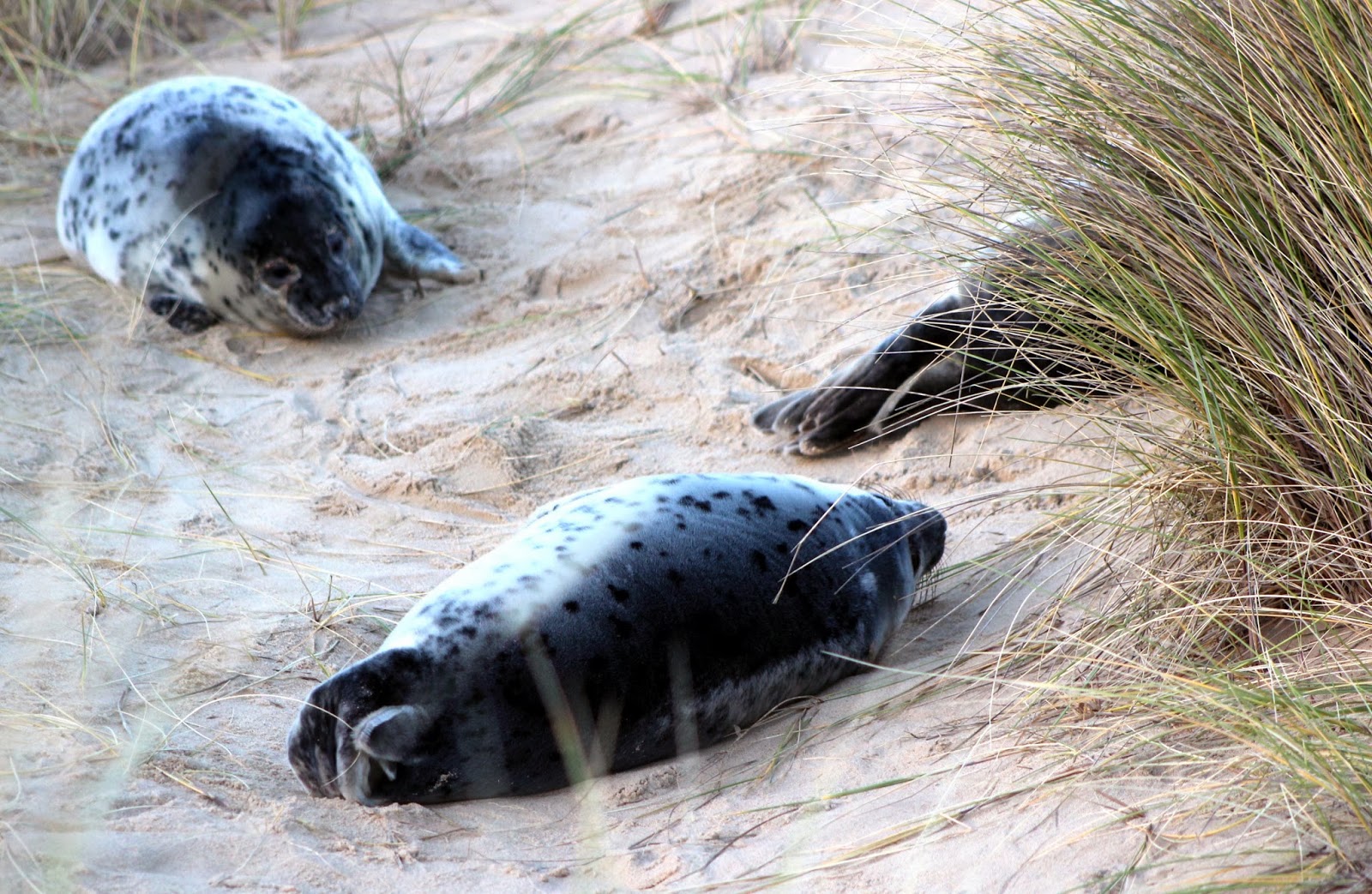
Seals at Winterton - Norfolk Coast


A terrific walk along the coast at Winterton. Having learnt our lesson last year we chose to avoid Horsey, as the popularity of the seal pupping draws an astonishing crowd over the Christmas holiday. The seals here, and along the coast at Blakeney spit, have raised well over 1000 pups this year and although many were briefly washed away by the pre-Christmas tidal surge and storm it now appears that most managed to find shelter, although some were rescued. Walking along the big open beach was as beautiful and inspiring as ever with the children running ahead and the boys leaping off the sand dunes. A large bull seal watched us from the surf as it made it's way along the coast, the large black head appearing briefly with a snort and a peak at us on the sand looking back. As the dunes levelled out into a series of sheltering rises we began to find evidence of this years breeding, 3 seal carcases in quick succesion, all young and probably only a month of 2 old having recently developed their dappled coat. The young seals, born at about 30lbs, put on 4.5lbs a day feeding from their mothers 60% fat milk. Once they reach about 100lbs and loose their white coats the mothers abandon the pups inthe dunes where they remain in little groups until they are hungry enough to make their way to the sea and begin the next stage of their lives. Although only about 5% die as young pups, 50% don't make it through the first year, a measure of the rough start they must get when they first crawl into the wintery North Sea. It's always tremendously exciting to see the seals in the dunes and particularly so with our children, knowing that they will remember these moments on this beautiful shoreline and perhaps bring their own children back in years to come.