Monday, 30 December 2013

5 Marsh Harriers

A wet, muddy but beautiful evening walk at the Strumpshaw bird reserve, Norolk. I grew up here, in Strumpshaw not in the reed-beds themselves, and the smell of the dykes, emotive call of the coots and the cough of the pheasants are all familiar and take me straight back to a childhood spent exploring with my friends, binoculars and fishing rod. We talked to our friend John, RSPB warden in the hide, and he let us scan the reed fringes with his telescope in the hope that we might spot an evening bittern. Others have seen bittern and otter within the last 24 hours and the excited scrawls on the clip board records in both hides bear testament to the close proximity of these wonders, but today they eluded us. We took the bold decision to walk to the river (Yare) and then on to the tower hide, the best part of a mile into the deserted reserve. With children largely carried and skidding in the mud we made it to the hide and climbed the wooden steps to look out over the sunset and the birds coming in to roost. Geese, ducks, small waders and a flock of excited lapwing were all settling on the small pools. The highlight of the walk was watching 5 marsh harriers tumbling in the wind over the reed-beds. We saw them a number of times over the hour before the sun set, briefly hunting over the beds on the south side of the river towards Claxton before returning, harried by rooks, to their roost. Perhaps they are parents and young, or a group of young birds working together in some way ? We trudged and slipped through the mud on our return to the van, arriving home in the dark.


Saturday, 28 December 2013

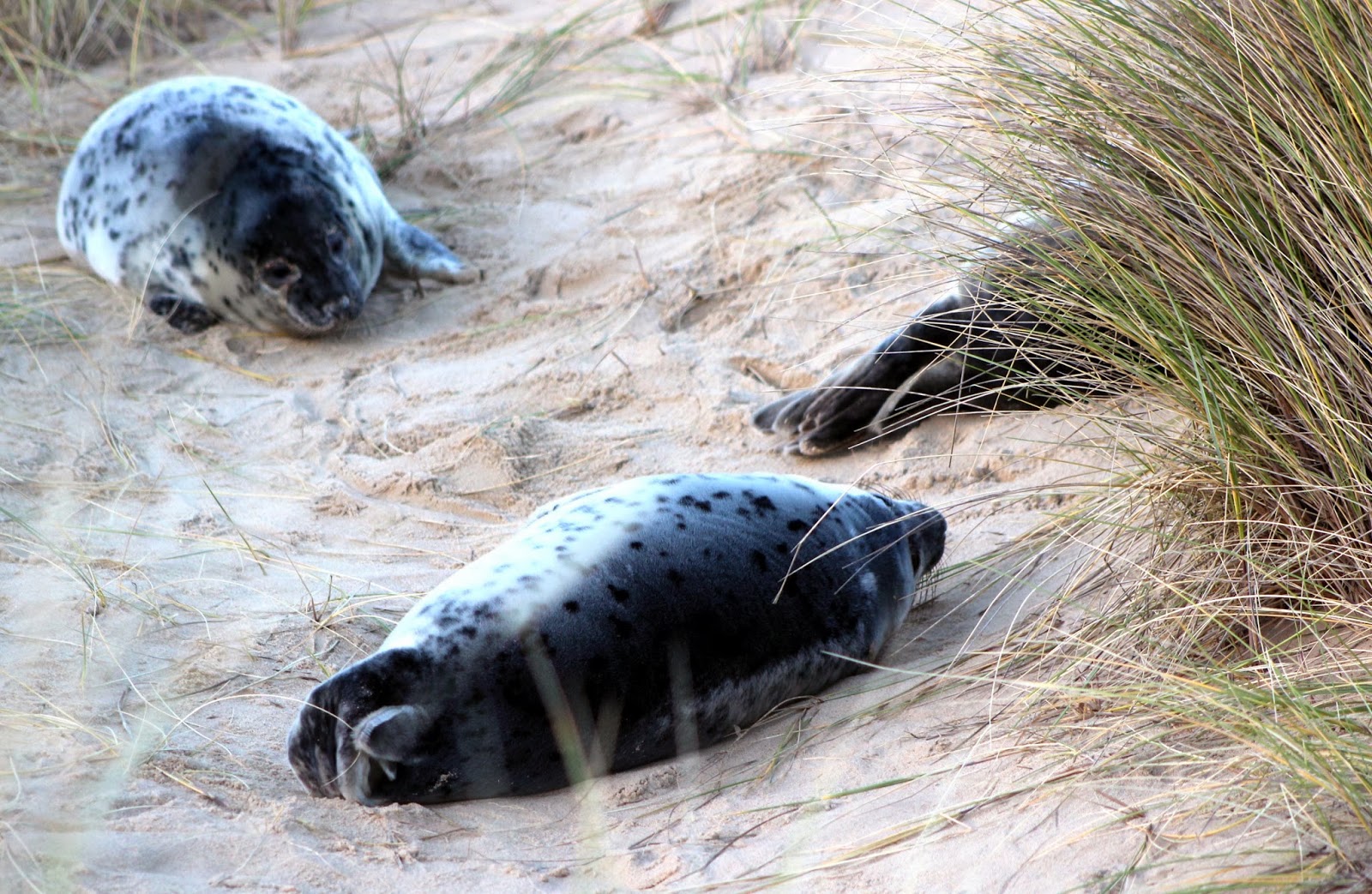
Seals at Winterton - Norfolk Coast


A terrific walk along the coast at Winterton. Having learnt our lesson last year we chose to avoid Horsey, as the popularity of the seal pupping draws an astonishing crowd over the Christmas holiday. The seals here, and along the coast at Blakeney spit, have raised well over 1000 pups this year and although many were briefly washed away by the pre-Christmas tidal surge and storm it now appears that most managed to find shelter, although some were rescued. Walking along the big open beach was as beautiful and inspiring as ever with the children running ahead and the boys leaping off the sand dunes. A large bull seal watched us from the surf as it made it's way along the coast, the large black head appearing briefly with a snort and a peak at us on the sand looking back. As the dunes levelled out into a series of sheltering rises we began to find evidence of this years breeding, 3 seal carcases in quick succesion, all young and probably only a month of 2 old having recently developed their dappled coat. The young seals, born at about 30lbs, put on 4.5lbs a day feeding from their mothers 60% fat milk. Once they reach about 100lbs and loose their white coats the mothers abandon the pups inthe dunes where they remain in little groups until they are hungry enough to make their way to the sea and begin the next stage of their lives. Although only about 5% die as young pups, 50% don't make it through the first year, a measure of the rough start they must get when they first crawl into the wintery North Sea. It's always tremendously exciting to see the seals in the dunes and particularly so with our children, knowing that they will remember these moments on this beautiful shoreline and perhaps bring their own children back in years to come.


Saturday, 16 November 2013

Early Murmeration


First visit to Ham Wall bird reserve this year to see the starlings. Adam and Bec staying with us and we squeezed in a little walk at sunset before we headed off to the wonderful Somerset Carnival in Glastonbury. As soon as we got out of the van it was clear that, in-spite of my fear that we were too early in the season, there were indeed starlings gathering. Clouds of birds were making there way past, low in the sky and heading towards the reed-beds in Shapwick Heath. I had heard that the murmeration was divided this year and thought that perhaps we were at the wrong site but there were still groups gathering over the familiar site at Ham Wall. As the birds came in from all directions, after a day's feeding on the fields and cattle troughs, they funnelled into the reeds without much delay. Groups  of hundreds swelled over the reeds on occasion as they jostled for roost space but the large murmeration seemed to have eluded us. Then as the thousands of birds chattered in the reed-beds a marsh harrier came over and suddenly the huge mass of birds was airborne, as one - (See very blurred phone photo above as I gawped) - The marsh harrier was clearly rather disorientated and sloped away over the reeds to pursue less dramatic quarry as the birds bulged and swelled before re-settling into the roost. It was great to share the local seasonal spectacle, it really is such an amazing sight and it's only going to build as the winter begins to bite.

Wednesday, 23 October 2013

Hummingbird Hawk Moth

Lepidoptera watch continues...we had a Hummingbird Hawk Moth in the garden this weekend. Fabulously exciting insects - large, exotic and scarce - I've never seen one. I didn't get a photo unfortunately as it was a fleeting visit but here's one culled from the BBC. Apparently the mild summer and autumn weather has attracted quite a few migrants from the continent.

Our one was enjoying the nectar available to long-tongued species from the Nicotiana by the back door. This plant has been a great hit with moths all late summer, notably in the evening when its scent is quite heady although this particular visitor was in the morning. It was spotted by my visiting Uncle Bill, rather fittingly, as he was the first person to introduce me to moths and butterflies when I were a lad!

Sunday, 20 October 2013

Pupa on the wall.


There are three of these beautiful and distinctive pupa attached to the side of my house and they appeared about 2 weeks ago - 19mm in length. (*photographed with a DSLR, 35-80mm lens and macro extension rings) They are clearly the pupa of a butterfly or moth and are all of the same species. The caterpillars must have crawled quite some distance to get to the side of the house, as the wall is separated from the plants and flowerbeds by a wide concrete walkway, so I can only assume that some genetic trigger in their little brains says that they must find a wall of significant height so that when hatching from the pupa they are well above the ground. Each of the beautiful pupae have a square of 4 highlighted spots, almost as if they have been delicately gold leafed. Q - How does a small caterpillar judge the height of the thing that it is climbing ? What species are these ? - I have so much to learn.

Surface detail:


Jo Donnelly, (Ecologist) - Identified my last caterpillar as probably that of a 'Grass knot moth'
Thankyou Jo.
Note: Thanks Ads - as I note that you had already come to the same ID conclusion in the comment stream attached to blog post, thanks also.

Monday, 7 October 2013

Common Hawker

At RSPB Minsmere - I think a Common hawker Aeshna juncea. Just amazing insect life there on a sunny Autumnal day.

DSCF6828