Sunday, 22 April 2012

The Cruellest Month?

T S Eliot's 'cruellest month' is certainly doing its best to live up to that description - after a balmy March, torrential rain and chilly winds have beset us for weeks now. But nature continues its oft-repeated patterns and spring is well underway, with the fields and lanes increasingly verdant. This year I have been struck by the profusion of dead nettles (Lamium purpureum and alba). These are easily overlooked, although were probably the first wildflowers I learnt due to the crucial difference from their stinging counterparts, and their little nectar sweetness that as children we would sup. The bumblebees clearly enjoy their nectar load as well, as early flowers when few other options present themselves. As ever, I am not sure whether it is a good year for the species, or whether I just happen to have noticed them more this year...

The other wonderful sign of spring's progress over the weekend was the returning martins and swallows. I saw a solitary House Martin last Thursday (19th) and then the first swallow this morning (22nd), followed by several others resting on wires, and recouping their strength feeding on insects after their huge migration. As ever I think of Owen Sheers's delightful lines that 'the swallows are italic again'. This was slightly later than the first swallow I saw last year (16th April), maybe an actual delay due to the unsettled weather or again down to my observation. 


Either way, there was a slight desperation in my scanning the skies over the last few days (where are they? Why aren't I seeing them?) followed by a palpable relief and joy when their familiar sky-flit appeared again as if they had always been there, how could I have doubted them? Ted Hughes describes the sight of returning swifts proving that 'the globe's still working'. For me that thought chimes with another, that the sight of these birds connects us physically to the south, their migration suggesting a notional line on the globe linking our little patch of south Norfolk with sub-Saharan Africa, which I find humbling and strangely reassuring.

Sunday, 15 April 2012

First House Martins

As we left the garden centre this afternoon I saw a group of four house martins tumbling about in the sky, the first of the year.

A friend on Facebook said that she saw a swallow last week but I haven't seen one yet, or any swifts, but these were certainly martins. I have however seen a lot of buzzards recently and many being mobbed by crows with jackdaws also full of beans stealing moss from our roof and other nesting materials or food from the garden. I've also unusually seen three foxes in the daylight in the last 10 days, the one yesterday on the back road near Mere, stopping to look at us nonchalantly as it trotted across the road 20 yards ahead of us. Adam and I found fox scat on the marshland in Claxton, and in it a small claw, possibly another young owl fallen from a nest and scavenged perhaps ? The foxes have presumably got the wind in their sails as they busily support young cubs in their dens and have to keep food on the family table.

Wednesday, 11 April 2012

Releasing Cellar hostages

I took the children down my Mum's cellar with torches on a traditional holiday adventure and we found a number of newts and frogs. As a child I used to find loads of frogs in the cellar but we had the wherewithal to largely block up the hole into the garden to stop this happening as they crawled under the concrete cover and fell through the grating in what was a very effective amphibian pit-fall trap. Even with this resolved a small number still clamber into the hole every few months, fall through the grate and are unable to get back out. There are always hibernating mosquitoes in the cellar but these are probably pretty thin pickings and so the trapped frogs and newts have little to eat and their diminished bodies are evidence of this. We carefully caught 7 young smooth newts and two pale common frogs and released them into the pond in the garden which felt like a triumphant success after the sadness of the dead baby owl.


Roosting Owls

While visiting Strumpshaw my children found a dying baby owl beneath a tall ash tree in the woods. They had been trying to feed it worms and it was still able to open its mouth and clasp it's tiny claws. Having looked at the RSPB owl advice online, (*for fledged young leave well alone) I phoned the 'Raptor Trust' ( www.raptortrust.org.uk ) and a volunteer came around to collect it. Unable to replace the owl into the nest, as it was too high, we had placed the baby owl into a box and bought it inside to keep it warm out of the rain but it was dead when the man arrived. Young tawny owls often fall from the nest site while they are fledging and learning to fly but this was only a nestling and so had either climbed and toppled or had been pushed out by it's siblings perhaps. Its apparently quite common for baby owls to fall out of the nest in this way and when we looked carefully we could see the mother owl still sitting on the nest high up in the tree. I returned the next morning and she was still sitting there, beautifully camouflaged and with her back out to the weather and her head turned in readiness, hopefully still guarding other unfledged chicks. Adam and I searched for other evidence and Adam impressively spied an owl pellet in the garlic beneath the tree although I admit that we would never have spotted the owl if it hadn't been for the fallen nestling.

I am away back to the west Country now but Adam may return in a few weeks to see if he can see any evidence of the young tawny owls beginning to stretch their wings as they grow up and explore around the nest.


Tuesday, 10 April 2012

The delights of Minsmere continued

Following on from Duncan's eulogising the sights of RSPB Minsmere, I would add that the sounds of the place also spoke of the abundant wildlife. Chiffchaffs, great tits, chaffinches and other woodland birdsong serenaded our walk through the woods to the bittern hide, where I first heard the 'boom' of the bittern.

Bittern
I've never knowingly heard this before and it was only Dunc's pointing it out that drew my attention to it. There must be something about the sound - its frequency or lack of attack - that makes it fade into the background, as does the bird itself into the reeds. I suppose there is an advantage to making a distinct but unobtrusive sound, that others of the same species can hear for territorial or mating purposes, but that does not draw undue attention to itself. Either way, I had not 'tuned in' to it until that point - I then realised that I had in fact heard it that morning when I'd popped in to the hide but had not identified it. Unfortunately I was not able to record the sound but you can hear it on the RSPB page about the Bittern.

The other sounds that stood out were the ear-splittingly loud call of Cetti's Warbler which was singing out across the reed beds, piercing and unique. Again, no recording of it, but the sound that I did capture, and which formed a constant background to the day was the cacophony of gull squawks, goose honks and duck quacks produced by the massed ranks at the scrape. It's not the most beautiful sound in the world (certainly not as beautiful as the skylark song I recorded recently) but is quite overwhelming and really stood out for me.


The irony is that possibly the most reclusive creature that we saw, the water vole, is only usually heard as a loud 'plop' as it enters the water, but we didn't hear this. It was quite by chance that I leant over to see where a wren had just flown and saw the water vole swimming across a narrow dyke. It was clearly a day of technical inability on our parts however, as my attempt to photograph it resulted only a blurred grey blob - you'll just have to take my word for it! A day that will live long in my memory.

Inquisitive Seals

Went for a morning walk along the coast at Horsey gap to see if we could see any seals hauled up on the beach. We walked for about half a mile along the tide line picking up mermaids purses and found three small dead sea mice. We were followed for the whole walk by two seals which observed us from the shore edge consistently and this is behaviour that I've seen before. They were clearly interested in what we were up to and stayed within a couple of meters of the shore, with their backs in a couple of feet of water so that they felt safe. We walked as far as the rock breakwater and there were indeed two seals up on the beach which were tussling with each other before they rolled into the water on our approach. Beautiful but cold spring morning and as we walked back we found tracks of seals, that had made there way up into the dunes even this late in the season, clearly recognisable as webbed paw prints in the soft sand.


Terrific spring day at RSPB Minsmere

After a great few hours drinking cups of tea at the coastguard cottages and looking for elusive adders and ant lions, on Dunwich Heath and the beach, a small group of us went on to the RSPB reserve at Minsmere.


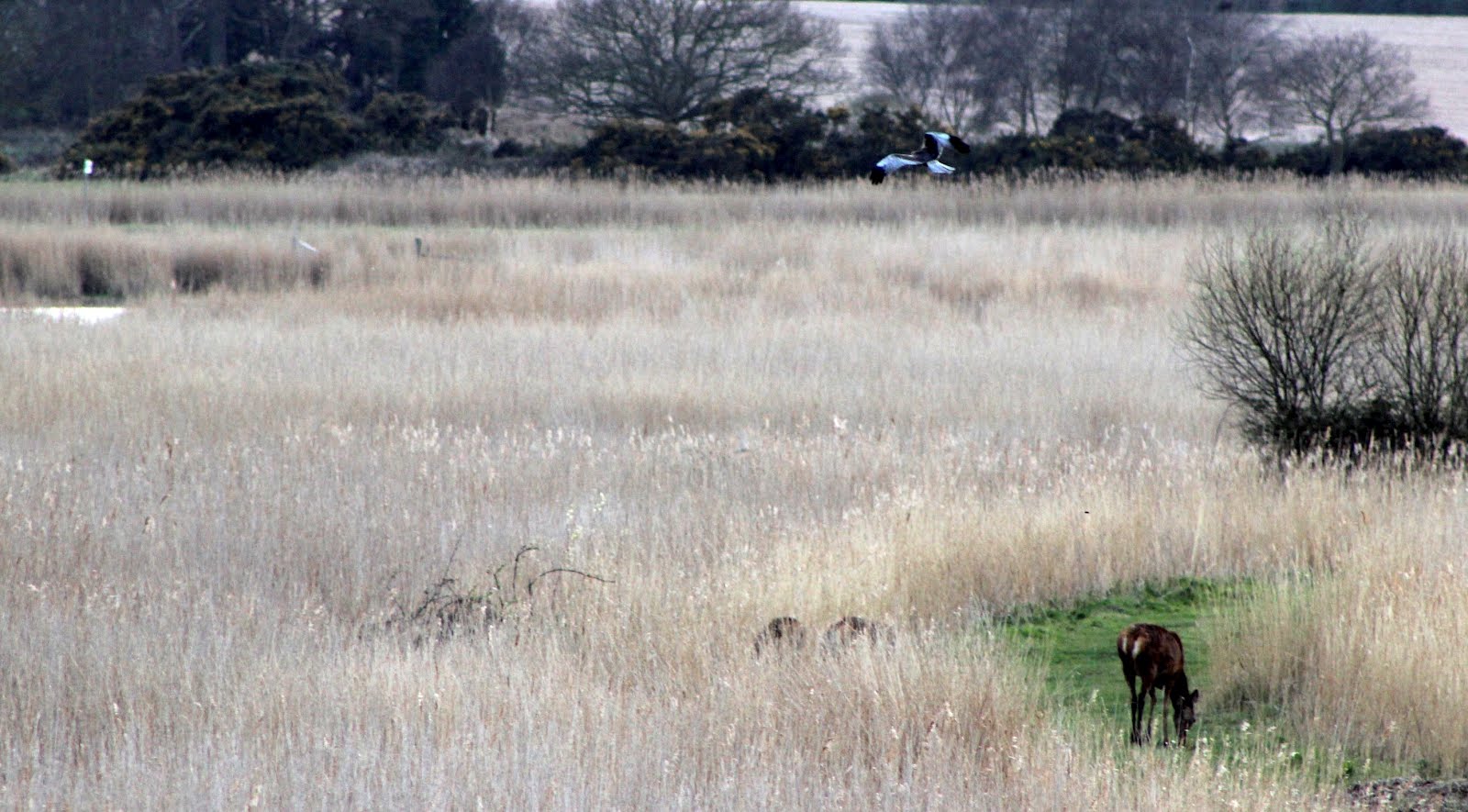
What a wonderful place. In summary we were there for an hour and watched muntjack deer feeding in the woods, red deer on the marshes, marsh harriers and egrets flying over the reed beds and astonishingly two bitterns wading in the shallows. I have never seen bitterns at such close quarters and we watched one creep back into the reeds, within 20 feet to the right as we arrived at the appropriately named bittern hide, and then 10 minutes later a second stalked out of the reed beds to the left and caught a small fish in amongst the reed stems. I was so taken aback by seeing bitterns at such close quarters that I had my camera settings all over the place and didn't get very good photographs. The second bittern was out in the open for at least 5 minutes and struck all of the characteristic poses with its thick neck out straight, peering into the sky and then down again into the water lifting its large feet and green legs as it stealthily stepped amongst the reed stalks. So pleased that Alexander, my seven year old son, was able to watch the bittern through the binoculars and at one point we could see a bittern, a marsh harrier and a herd of red deer at the same moment. Walked back smiling, via the hide over the scrape, and amongst many other things we saw a water vole in the path-side dyke, heard a cetti's warbler calling and listened to the distant haunting bottle top boom of the bittern.